
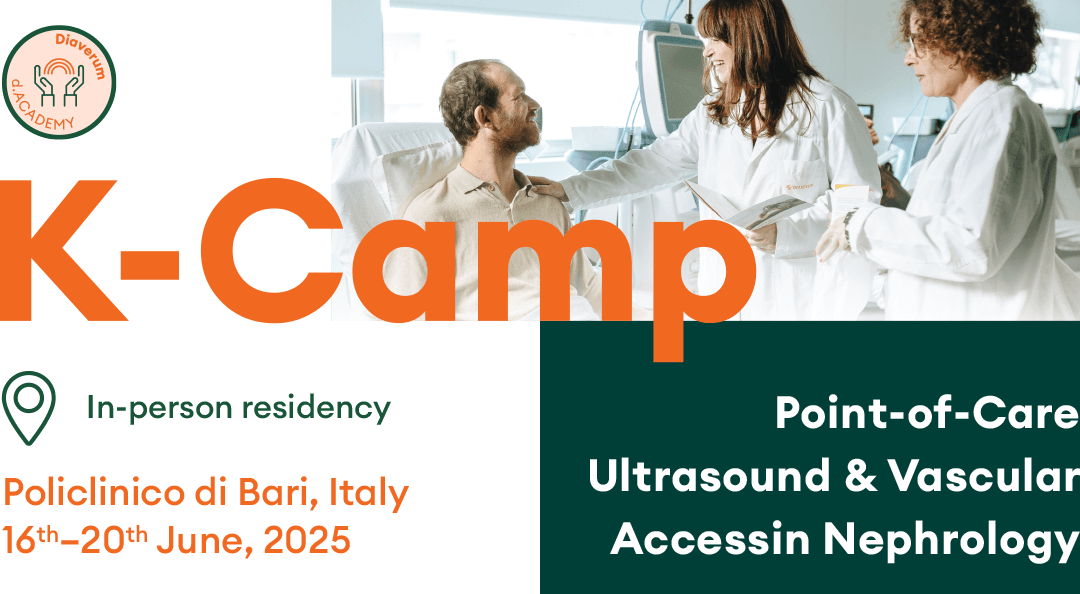

A hands-on training programme covering ultrasound techniques, vascular access procedures, and clinical decision-making.
↳ Format: In-person residency
↳ Suitable for: Nephrologists
↳ Duration: 1 week
↳ Date: Monday, 16th – Friday, 20th June 2025
Registrations are closed
This is not just another course.
This is your chance to lead.
To innovate.
To make a difference.
Rationale
The practical use of ultrasound in clinical diagnostics has experienced significant momentum in recent years, thanks to its well-known characteristics of accuracy, speed, safety, reproducibility, and low cost, making it an indisputably valuable and indispensable investigation tool. Ultrasound examination has now become an integral part of internal or nephrological examinations and is an indispensable tool in interventional procedures, particularly in the case of vascular access (VA) for dialysis.
The literature data demonstrate that dialysis vascular access significantly impacts the morbidity and mortality of patients undergoing hemodialysis and also results in a growing consumption of resources. Competence in VA represents an unavoidable educational need for anyone involved in dialysis, not only for nephrologists, who have always recognized the importance of “vascular access care” in the clinical care pathway of chronic kidney disease, but also for vascular surgeons, interventional radiologists, and dialysis nurses. The necessity of an interdisciplinary culture around VA arises from the increased complexity of patients and the need to offer personalized treatment of high quality and professionalism. However, due to organizational models that are not always adequate and structural limitations, dialysis VA is often relegated to a marginal role in nephrology training. In recent years, with the increase in the number of procedures performed on nephropathic patients directly by nephrologists, the figure of the interventional nephrologist has emerged.
Therefore, within the realm of VA, educational activities and training programs must aim to develop the multidisciplinary competencies and skills necessary for nephrologists to assume the role of team leader, ensuring comprehensive and appropriate management of VA. All this, according to the best international practices and guidelines, with particular attention to patient preferences, treatment goals, and safety. It is also necessary to promote and disseminate the culture of VA, with the aim of making all stakeholders aware of the clinical impact it can have on patients and its economic implications. Nephrologists must establish a leadership role within the multidisciplinary team dedicated to the care of patients requiring VA. Only well-coordinated and integrated care can ensure the best possible treatment for the patient’s needs.
Scientific Program
DAY 1 – 16th JUNE
08:30-09:00
Registration
09:00-09:30
Welcome Ceremony and Presentation of the course – N. Campobasso, M. Fiorentino, L. Gesualdo, C. Lucas
09:30-10:30
Becoming familiar with US machine and its setting – G. Piscopo
10:30-11:00
Point of care ultrasound in the practice of nephrology – A. Mascolo
11:00-11:30
Coffee break
11:30-13:00
How to conduct an abdominal US examination: US anatomy of the mainabdominal organs – T. Piccolo
13:00-14:30
Lunch break
14:30-17:00
Practical activity day 1
Focus on abdominal US examination – G. Piscopo, A. Mascolo, T. Piccolo
DAY 2 – 17th JUNE
09:00-09:30
Knowing color-Doppler principles and its applications – M. Forcella
09.30-10.00
How to perform arterial and venous eco-color-Doppler examination – M. Forcella
10.00-11.00
Point-of-care ultrasonography in patients with AKI – M. Fiorentino
11.00-11.30
Coffee break
11.30-12.30
Assessment of tissue and vascular congestion: LuS & VeXUS in renal care – K. Espinoza
12.30-14.00
Lunch break
14:00-17:00
Practical activity day 2
Focus on eco-Doppler examination – G. Piscopo, M. Forcella, K. Espinosa
DAY 3 – 18th JUNE
09:00-09:30
Interventional nephrology: The Vascular Access Team – L. Gesualdo
09:30–10:00
Epidemiology of Vascular access – The Italian Survey – C. Cortese
10.00-10.30
Human topographic anatomy of upper and lower arm – F. Bagagli
10.30-11.00
Coffee break
11.00-12.30
Physical Examination of the arterio-venous vascular access for hemodialysis – L. Carlos
12.30-13.00
Pre-operative vascular mapping – J. Ibeas
13.00-14.30
Lunch break
14:30-15:00
Patient safety and VA – M. Gallieni
15:00-17:00
Practical activity day 3
Focus on vascular mapping – C. Lomonte, C. Cortese, A. Pesino
DAY 4 – 19th JUNE
09:00-09:30
AVF: guidelines and operating room requirements – F. Bagagli
09:30-10:00
Native proximal and distal AVF, endovascular AVF – C. Cortese
10:00-10:30
AV graft – N. Grandolfo
10:30-11:00
Coffee break
11:00-13:00
Practical activity day 4
Focus on AVF creation – F. Bagagli, A. Pesino, C. Cortese
13:00-14:00
Lunch break
14:00-14:30
What the Computational Hemodynamic of AVF teaches to nephrologists – S. Poloni
14:30-15:00
AV Access Monitoring and surveillance – C. Lomonte
15:00-15:30
US parameters of AVF maturation – A. Pesino
15:30-16:00
VA Complications: surgical and endovascular approach – C. Cortese, N. Grandolfo
16:00-18:00
Practical activity day 4
Focus on AVF surveillance – F. La Fergola, A. Pesino, C. Cortese
DAY 5 – 20th JUNE
09:00-09:30
Central Venous Catheters (non-tunneled and tunneled) – F. La Fergola
09:30-10.00
CVC dysfunction – C. Lomonte
10:00-10:30
CVC infection – F. La Fergola
10:30–11:00
Coffee break
11:00-12:00
Central Vein Thrombosis, Central Vein Stenosis – R. Inchingolo
12:00-12:30
Ultrasound in CVC placement – A.M. Di Palma, G. Piscopo
12:30-13:00
Closing Ceremony – M. Fiorentino, C. Lucas, R. Romanini
13:00-14:30
Lunch break
14.30- 17.00
Practical activity day 5
Focus on CVC – F. La Fergola, C. Lomonte, C. Cortese
Scientific Committee Members
Prof. Loreto Gesualdo
Full Professor of Nephrology, University of Bari Aldo Moro, Italy
Prof. Marco Fiorentino
Nephrologist, University of Bari, Italy
Prof. José Ibeas
Director of Nephrology, Hospital Universitari Parc Taulí, Barcelona, Spain
Dr. Carlos Lucas
Corporate Global Medical Director, Diaverum, São João do Estoril, Portugal
Dr. Nicla Campobasso
Medical Director, Diaverum, Bari, Italy
Faculty
Dr. Francesca Bagagli, Bari
Dr. Cosma Cortese, Bari
Dr. Anna Maria Di Palma, Bari
Dr. Karla Espinoza, Spain
Dr. Mauro Forcella, Foggia
Prof. Maurizio Gallieni, Milan
Dr. Nicola Grandolfo, Bari
Dr. Riccardo Inchingolo, Bari
Dr. Francesco La Fergola, Bari
Dr. Carlo Lomonte, Bari
Dr. Carlo Lucas, Portugal
Dr. Alessandro Mascolo, Bari
Dr. Alessandra Pesino, Bari
Dr. Tiziana Piccolo, Barletta
Dr. Giovanni Piscopo, Bari
Dr. Anna Maria Di Palma, Bari
Dr.ssa Sofia Poloni, Bergamo
Dr. Rafael Romanini, Portugal
EACCME
An application has been made to the UEMS EACCME® for CME/CPD accreditation of this event.
TARGET AUDIENCE
Nephrologists, vascular surgeons, interventional radiologists, dialysis nurses and other healthcare professionals involved in the care of dialysis patients.
The certification of credits is subject to 100% participation in the entire training program and to learning verification and it will be available at www.aristeaeducation.it no earlier than 60 days from the closing date of the event.
C.M.E. PROVIDER

Via XII Ottobre, 1 – Piano 6 • 16121 Genova • Italy
Tel. 010 7766457
E-mail info@aristeaeducation.it
Web www.aristeaeducation.it
ORGANIZING SECRETARIAT

Via Roma, 10 • 16121 Genova • Italy
Tel. +39 010 553591
E-mail genova@aristea.com
Web www.aristea.com